Sunday, March 10, 2013

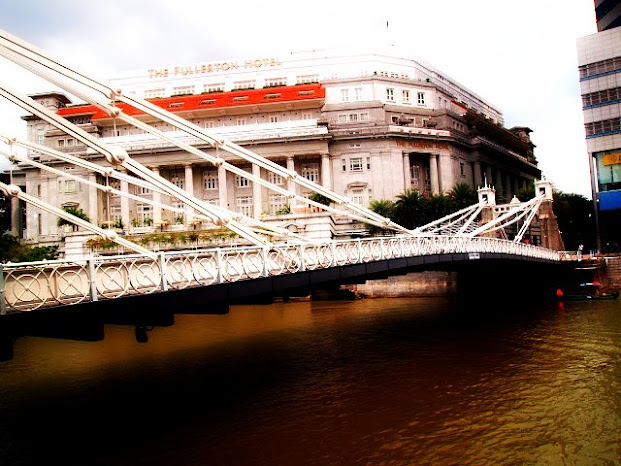
Site 13 Coleman Bridge


Coleman Bridge, which links between Hill Street and New Bridge Road, was named after George Drumgoole Coleman. Coleman was the designer of the first Coleman Bridge. He was also the first Superintendent of Public Works, as well as Singapore’s first architect.


read more

Site 14 Ministry of Information, Communications and the Arts (MICA)

-->

We are standing right opposite of the colourful MICA

Ministry of Information, Communications and the Arts (MICA) is a national monument, which was built in 1934 to house the Hill Street Police Station and Barracks. It was originally known as the Old Hill Street Police Station (OHSPS) before it was renamed as the MICA Building in 2000. However, when MICA became the Ministry of Communication and Information, the building was later renamed again as the OHSPS in 2012.
read more

Site 15 Clarke Quay


Who was Clarke Quay named after? What did the area use to house?

Clarke Quay was named after Sir Andrew Clarke, the Governor of the Straits Settlements from 1873 to 1875. The area was used to house the colonial government's gunpowder and magazine, coal stores and private properties, before it was transformed into a godown centre and a fresh water distribution point for ships during the second half of the 19th century.

History and significance of building in Clarke Quay: Whampoa’s Ice House
Whampoa's Ice House
Can you find The CanneryRiver House, and Whampoa’s Ice House? What was the history and significance of these buildings?

In 1854, Whampoa's Ice House was Singapore's first ice house that sold imported ice from the frozen winter lakes of New England, the United States of America. It was established by Hoo Ah Kay (1815-1880), a businessman who was also known as Whampoa (named after his hometown in Canton, China). However, the venture was short lived due to an overestimation of the demand for ice.

The original building was later demolished in 1981 for the purpose of widening the River Valley Road. The Whampoa’s Ice House that can be seen today is actually the replica of the original that was constructed near its original location.
read more

Site 16 Read Bridge


Read Bridge is still as famous as it used to be in the past. Back in the old days, it was a popular gathering venue among labourers to listen to storytellers. Today, it is a lively meeting nightspot for Singaporeans and foreigners.

The bridge was built in 1889 and it was named after a prominent merchant, William Henry McLeod Read. It was primarily built to resolve the problem arising from another bridge called the Merchant Bridge. Due to the fact that the Merchant Bridge was not built high enough to allow boats to pass under it during high tide, the Read Bridge was built to replace it.

At one point of time, the area around the bridge was also a well-known region. The upstream area from the Read Bridge used to be the vibrant fuel center. The region was known as Kampong Melaka as the main supply of fuel mostly came from Malacca. Owing to that, Read Bridge also became known as Malacca Bridge. 


Nearby historical building - Masjid Omar Kampong Melaka

As much as we wanted to locate the mosque, we were unable to do so. Perhaps, we had missed it but we managed to find the some information about this building.

Masjid Omar Kampong Melaka was built in 1820. As the name suggests, ‘Masjid’ means mosque in Malay and it was the first mosque and house of prayer in Singapore. The mosque was named after Syed Omar bin Ali Aljunied, an Arab merchant from Palembang.
read more

Site 17 Ord Bridge

Ord Bridge is behind us

Ord Bridge was built in 1886 and it was named after the first Governor of the Straits Settlements, Colonel Sir Harry St. George Ord (1819-1885), after it was bestowed the status of Crown Colony. The bridge has several other names as well.

The first was its old name, the Ordnance Bridge before it was later abbreviated to the current name. The second was known as the ABC Bridge as ABC Bridge was a demolished footbridge, which Ord Bridge was to replace. The third was known as the Toddy Bridge as it was located near to the toddy (coconut wine) shops on nearby Pulau Saigon.
read more

Zhen Xi's Reflection

Heritage trails were always so boring and similar in my primary and secondary school days. Why? Because I could not really appreciate the significance of the heritage sites.

But that was what I felt many years ago. This time, it is still forced upon us as an assignment but yet I am no longer bored out but feels grateful for this opportunity to explore the heritage trail of the Singapore River.

It is a central area where I frequent for shopping trips or a place of interest when my relatives visit from overseas. However, I had little idea on the stories or meanings behind each and every bridge or even statue. Take for example the First Generation, showing 3 boys jumping into the Singapore River. The question that we were to answer was whether the boys were truly as carefree as they looked. It made me think and tried to imagine what it was like in the past. And what I thought was that it was one of the few sources of recreation for them that was free. The people in the past especially those living by the Singapore River were mainly coolies. They would not be able to make much money to afford toys. Hence they are not carefree in economic terms but definitely carefree in their childhood with many games and recreation they can find.

Bridges were just a way of transport over the river but I never knew they dated back quite a while and were named after important people of the colonial regime. Fullerton Hotel was just a 5-star hotel which i couldn't afford to stay in, but I never knew it was once a post office. Through this trail I really learnt a lot about the river and I can now better appreciate the buildings and structures.

:)

Mr Deng Xiao Ping and me. I found his head on the trail! XD

read more

Sandy's Individual Reflection


The heritage trail was an eye-opener for me. Having been living and growing up in Singapore, as well as going for countless learning journeys in my academic years, there were still so many things I've not learnt and encountered prior to the heritage trail. An example would be the origins of the names of the bridges (Coleman, Elgin, Ord, Cavenagh and Read). Prior to the heritage trail, I have never really bothered about why the names of our bridges were named as such.

If one were to compare Singapore's history as that to China's or India's, it would definitely pale in comparison. Singapore, in my opinion does not have a rich cultural heritage. It seems that much of Singapore's history were made up, or lacked authenticity. An example would be that of the Merlion. I've always thought that the Merlion was a representation of what Sang Nila Utama saw. However, it was created by Lim Nan Seng in 1972, several years after Singapore's independence. It seems as though a mythical icon had to be created to substantiate Singapore's history.

However, I appreciated some of the recordings of Singapore's history. For example, I was amazed by 'The Fullerton Singapore'. It was interesting to know that Fullerton Hotel used to be Singapore's first and largest post office. Another example would be that of the history of Singapore River. The history of Singapore River has come a long way to what it is today, especially in terms of its economic activities. Without the recording of these events, it would be difficult for one to appreciate one's past.

Conservation and commercial reuse of historical sites in Singapore is necessary to preserve our historical heritage. I feel that having a physical representation of a historical site is more successful than not having any. When people pass by these historical sites, they will get to know of Singapore’s historical heritage and being in that place will give a physical representation of how it looked like in the past. However, to determine its success in preserving our historical heritage is dependent on how an individual is intentional in finding out more about Singapore’s past. As I’ve mentioned in the beginning, after going for the heritage, I realized that there are still so many things of Singapore’s past that I am oblivious about. It seems that while conservation and commercial reuse of historical sites is necessary in preserving our historical heritage, its success is questionable. Perhaps, more could be done to help Singapore’s historical heritage be made known.


read more
Blogger Template by Clairvo